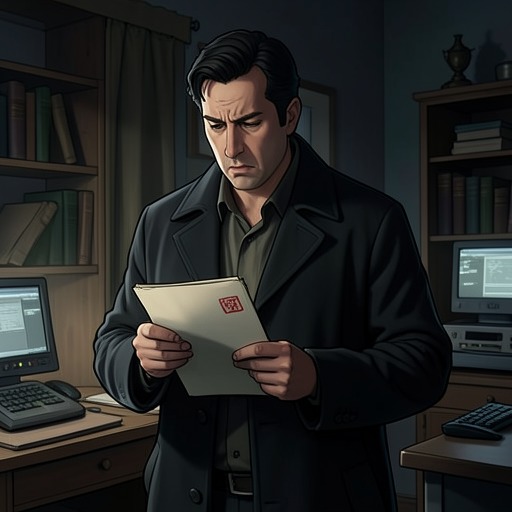
Ewert Grens decides to use lethal force
Three SecondsEwert Grens’s decision to use lethal force against Piet Hoffmann becomes a test of how far he will accept responsibility for a choice made under mortal pressure. Three days after the decision, Grens looks back on it alongside the death of his wife, Anni; his effort to refuse guilt culminates not in quiet absolution but in an accusation against others.
The decision under pressure
Three days before the later confrontation, Grens made a decision he had dreaded throughout his working life: to use a lethal shot against another person. The narration presents the choice as a boundary crossed, not as a routine exercise of police authority. Its weight lies both in the possibility of death and in the fact that Grens had long feared having to make precisely this kind of decision.
The surrounding prison crisis gives that choice a setting in which lives and official powers collide. Grens demands military assistance, insisting that someone’s life is at stake; John Edvardson answers that the armed forces cannot be used for police matters and invokes the governing ordinance. The exchange does not establish that this legal restriction caused Grens’s decision, but it places his demand for help against a formal boundary on what the police may call upon. His use of lethal force belongs to a crisis in which the urgency of saving life and the limits imposed by law are both explicit.
From action to guilt
When Grens revisits the decision, he describes having dared to make it. The phrasing marks a change from dread before the act to an attempt to face what it means afterward. He does not present the event as emotionally settled: he says he was not responsible for Hoffmann’s death, making the question of responsibility central even as he denies it.
The same reckoning reaches beyond the prison crisis. Grens recalls spending several hours in a cemetery the previous night, at a modest grave he had feared more than anything else he could remember. He also denies responsibility for Anni’s death. The passage places the two losses beside one another without making them equivalent: the lethal-force decision was his choice in the course of his work, while the cemetery visit confronts him with a private bereavement that has remained frightening. In both cases, however, he is trying to distinguish grief and consequence from personal culpability.
The accusation
Grens’s voice is remarkably calm when he declares that he did not commit murder. He then points at the people before him one at a time and assigns the accusation to them. The sequence turns his insistence that he is not responsible into an outward challenge: rather than allowing the deaths to remain an undifferentiated burden on himself, he identifies other people as the perpetrators of the crime.
That shift does not erase the decision he made. It changes the focus of the scene from Grens’s private fear of guilt to his claim that responsibility has been displaced or concealed by others. The repeated pointing gives the accusation a direct, individual force, while his restored calm contrasts with the dread attached to the decision and the grave.
Significance and aftermath
The episode links lethal authority to the question of who bears responsibility when a death follows a crisis. Grens cannot undo the choice, and his later words do not make its consequences disappear; instead, he separates the act of deciding to use force from the claim that he committed murder. His accusation suggests that the larger moral account must include those he confronts, not only the officer who made the lethal decision.
The cemetery visit and the confrontation form a paired reckoning. In one, Grens approaches a grave he has long been afraid to face; in the other, he turns toward living people and names them, one by one, as responsible. The decision therefore remains significant beyond its immediate danger: it becomes part of Grens’s struggle to confront two deaths without accepting a guilt he believes belongs elsewhere.